


The product roadmap a non-technical founder actually needs
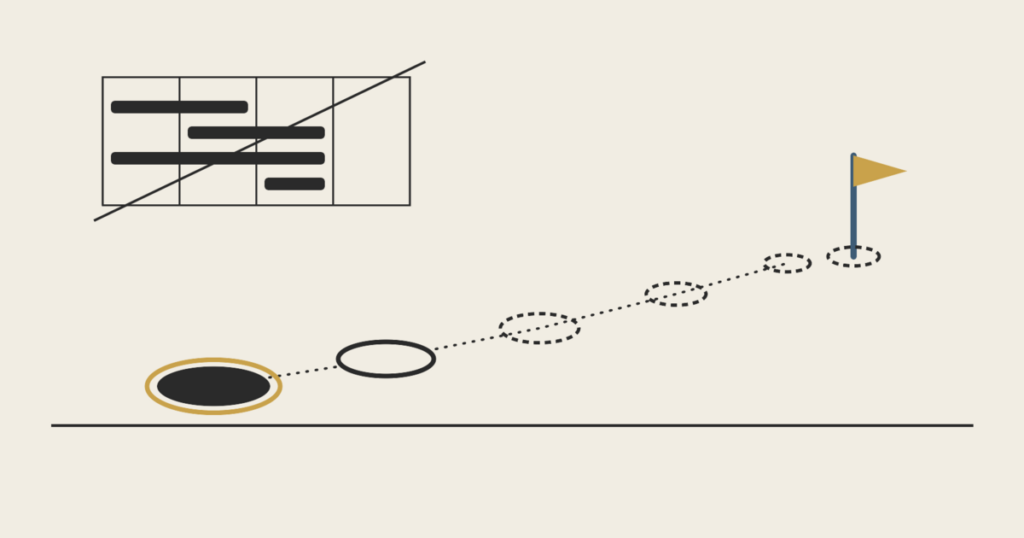
Why the quarter-by-quarter roadmap with fixed dates breaks too early, and the four-question routine that organizes what to build, in what order, with whoever is coding it for you.
A founder showed us her product roadmap six weeks after closing her seed round. It was beautiful: a Notion board with four columns, one per quarter, twenty-three features spread across colored bars running to December. She had copied the format from a Miro template. The problem showed up in the first meeting with the team that would build it. Nobody could say what needed to be ready first, or why. The roadmap looked like a promise to the board. It was useless as an instruction to the people writing the code.
A product roadmap is the document that says what your company will build, in what order, and with what business goal behind it. On paper, everyone agrees with that. In practice, most early-stage founders build the wrong version: a schedule with fixed dates that goes stale in two weeks. For a non-technical founder, someone who will not open the code editor and depends on a team or a partner to deliver, the right roadmap is something else. It is a sequencing decision, not a calendar.
What a product roadmap is (and what it is not)
It helps to separate three things people keep confusing.
The backlog is the list of everything that could be done. It is long, messy, and grows on its own. Nobody promises the whole backlog.
The schedule is a sequence of tasks with dates. It works when the work is predictable, like a construction job with a locked scope. Early-stage software is not predictable, so the schedule turns into fiction fast.
The roadmap sits in between. It answers a question the backlog and the schedule do not: given everything we could do, what will we do now, and why this order and not another. A good roadmap is a tool for communication and priority, not a deadline contract. The definition Google surfaces for this search already says as much: it is not a static schedule with fixed dates, it is an adaptable tool that connects the long-term vision to short-term tasks.
The difference is not semantic. It decides whether your team builds the right thing or just works through a list.
Why the quarter-based roadmap breaks too early
The four-column roadmap has a hidden premise: that you know, in January, what will matter in September. In a mature company, with a product in production and usage data, that premise sometimes holds. In a six-month-old company, it is almost always false.
You are still figuring out who your customer is, which problem actually hurts, and what they will pay to solve. Every week of real product usage shifts your list of priorities. When that happens, the fixed-date roadmap becomes a liability: either you ignore it (and it loses meaning), or you follow it to the letter (and build things that no longer matter).
There is a name for why these schedules blow up: the planning fallacy, described by Daniel Kahneman. Teams systematically underestimate timelines and costs, even when they know similar projects ran late before. A twelve-month roadmap with dates is the planning fallacy turned into a slide deck. It gives comfort and removes focus.
The real cost is not the delay. It is what you fail to learn. Every feature you commit to deliver on a date is a bet you placed before you had information. The further out the date, the worse the bet.
Sequence by risk, not by calendar
The mental shift is simple to say and hard to do: stop ordering the roadmap by when, and start ordering it by risk.
Risk here means uncertainty that can kill the product. Every product idea carries a few assumptions that, if wrong, bring the whole thing down. “People will trust money to an app from a brand they have never heard of.” “The doctor will trade their spreadsheet for our system.” “We can deliver this at a price that still makes the math work.” Those assumptions are your real roadmap. The build order should be the order that tests the most dangerous one first.
This inverts the instinct of most founders, who start with whatever is easy to build or nice to demo. Building the easy thing first postpones the only question that matters: does this work? Marty Cagan, of the Silicon Valley Product Group, sums up the right posture in one line: a roadmap should be about outcomes, not features. You are not planning to ship screens. You are planning to reduce uncertainty.
The four-question roadmap
When a founder asks us to help build a first roadmap, we do not start with the tool. We start with four questions. They fit on one page and organize any list of ideas into a defensible order.
1. Which assumption, if wrong, kills the product? That one goes first. Not the most-requested feature, not the easiest. The most dangerous. If you do not know whether people will pay, the first roadmap item is the smallest thing that makes someone pay.
2. What needs to be live for the next external event? Founders do not live in a vacuum. There is a next round, an anchor client who signed a letter of intent, a regulatory deadline. The roadmap anchors to that real event, not to generic quarters. Ask: what needs to exist, and work, before that specific date?
3. What can you learn more cheaply before building? Not every assumption needs code to be tested. Sometimes a landing page, ten interviews, or a manual simulation answers the question for a hundredth of the cost. Whatever can be answered without building leaves the engineering roadmap and moves into product discovery.
4. What is reversible and what is not? Reversible decisions (the color of a button, the copy in a flow) do not deserve roadmap space. Hard-to-undo decisions (the data architecture, the billing model, the platform) do. Put weight where the mistake is expensive.
Answer those four and the order almost appears on its own. What you are holding stops being a wish list and becomes a sequence of bets, from the riskiest to the least risky.
The roadmap is the contract with whoever builds
Here is the part the product templates ignore, because they were written for companies with an internal product team. If you are a non-technical founder, there is a good chance the person building your product is not you. It is a hired team, a software partner, a developer. And so the roadmap takes on a second job: it is the document that keeps you and the people writing the code aligned.
A vague roadmap is room for misunderstanding. “Payments system” can mean a one-week integration or a two-month recurring-billing engine. When the roadmap item is clear about the intended outcome (“the customer can pay a monthly subscription and receive an invoice”), the conversation about scope, timeline, and cost gets honest. When it is just a title on a colored bar, somebody is going to be disappointed.
That is why we treat the roadmap and the requirements document as parts of the same system. The roadmap decides the order; the requirement turns the next item in line into something buildable. A technology partner worth your money will help you write both, and will push back when the order makes no engineering sense. A good partner is not a black box. They show you the trade-off before they bill you for it.
How to build yours in an afternoon
You do not need expensive software or a course. You need a simple structure and the discipline to keep it honest.
Use three horizons instead of dates: now, next, and later. “Now” is what is in build or starts in the coming weeks, and it should be short, two or three items at most. “Next” is what comes after, if what is now confirms the assumptions. “Later” is the parking lot for ideas you do not want to forget but will not commit to. This format (popularized as now/next/later) has a rare virtue: it is honest about what you do not know. Nobody is held to a date they never promised.
For each item in “now,” write a sentence of outcome, not feature. “Cut signup time from ten minutes to two” says more than “redo the onboarding.” The outcome guides the hundred small decisions the team will make without asking you.
Review the roadmap on a fixed cadence, every two to four weeks, together with whoever builds. The review is the product. A roadmap that never changes is not stable; it is being ignored. The tool where you draw this (a spreadsheet, a Notion board, a Miro) is the least important part of the whole story. The sequence is what matters.
Before you move an item from “next” to “now,” run it through the same test you would use to decide which features come first: does it reduce the biggest uncertainty left? If not, it is probably in the wrong horizon.
The mistakes we see most
Three patterns show up in almost every first roadmap we review.
The first is confusing roadmap with backlog. The founder dumps sixty items on the board and calls it a roadmap. A roadmap with sixty items prioritizes nothing; it just records desire. If everything is on the roadmap, nothing is.
The second is selling the roadmap as a date promise to the investor. The board asks for predictability, the founder hands over a twelve-month Gantt, and from then on every delay becomes a hard conversation that did not need to exist. It is stronger to show the logic of the sequence (“we prove X before we spend on Y”) than to promise September.
The third is building what is easy instead of what is risky. It is the most human mistake, because shipping feels good. But speed building the wrong thing is not progress. It is just debt piling up faster.
A well-made product roadmap is not the one with the most boxes. It is the one that makes clear what the company’s next bet is, and why. For a non-technical founder, that clarity is worth more than any template: it is what separates a team that builds with intention from one that just works through a list nobody believes in anymore.
Frequently asked questions
What is the difference between a roadmap and a backlog?
The backlog is the list of everything that could be done, with no order or commitment. The roadmap is the prioritized slice: what you will do now and next, and why. Backlog is inventory; roadmap is decision.
Does a product roadmap need dates?
Early on, almost never. Fixed dates in a high-uncertainty stage become fiction. Prefer horizons (now, next, later) and anchor only to the next real external event, like a funding round or an anchor client. Detailed dates make sense once the product has usage and predictability.
Is there a simple product roadmap example?
The most useful format to start has three columns: now, next, and later. In “now,” two or three items, each written as an outcome (“allow monthly subscription payment”), not as a feature. It is an example that fits in a spreadsheet and says more than a template full of colored bars.
Which tool should I use to build the roadmap?
The one you already have. A spreadsheet, a Notion board, a Miro, or a Canva do the job equally. The tool does not improve the sequence; it only draws the decision you already made. Spend your energy on the order, not the visuals.
Who should build the roadmap if I am not technical?
You set the direction and the business priorities; whoever builds helps order by what is feasible and estimate effort. If you outsource development, the roadmap should be built together with the partner. It is the document that keeps both sides on the same page.