


Registering software with Brazil’s INPI: a guide for the founder who paid for the code
Registering your software with the INPI does not create your ownership of the system. It creates the proof. A guide for the founder who hired out the development and wants to know, with certainty, what is theirs.
The question landed on day three of due diligence. A founder we work with was closing his seed round when the fund’s lawyer sent over the document list: cap table, corporate records and, at item 14, “evidence of ownership of the software’s intellectual property”. He had three years of product in production, recurring revenue and not a single piece of paper saying the code was his. A software house had built the system, the contract covered deadlines and payments, and nobody had written a line about who ended up owning what.
Software registration at the INPI, Brazil’s National Institute of Industrial Property, is the instrument that solves half of that problem. It is the official registration of a computer program: a certificate stating that this code, in this version, existed on this date and belongs to whoever registered it. It is cheap, fast and entirely electronic. But it solves only half the problem, and the wrong half to solve first. Before rushing to the INPI, it is worth understanding what the registration protects, what it does not, and in what order a non-technical founder should build this protection. (A note for international readers: Brazil’s INPI is unrelated to the French institute that shares the acronym; everything here is about the Brazilian system.)
What the registration protects, and what it does not
In Brazil, software is protected as copyright, not as industrial property. The legal basis is Law 9,609/1998, known as the Software Law, which extends to computer programs the same regime that covers books and music. Protection lasts 50 years, counted from January 1st of the year following creation, and holds in every country that signed the Berne Convention, which in practice means almost the entire world.
That detail changes everything, because copyright is born at creation, not at registration. Your software is already protected today, even if you have never heard of the INPI. Registration is optional under the law.
So why register? Because protection without proof is worth little. If a former contractor launches a competitor built on your codebase, the dispute will not be about whether copyright exists. It will be about who created what, and when. The INPI registration is the cheapest way Brazil offers to manufacture that proof in advance: an official third party, with legal standing, attesting to the existence and authorship of that version of the code on that date.
What the registration does not do: it does not protect the idea, does not protect functionality and does not stop anyone from building a product that does the same thing with their own code. Copyright protects expression, meaning the source code itself. A competitor who replicates your onboarding flow screen by screen, writing their own code, does not infringe your registration. If that is your worry, the path is different, and we covered it in the guide on how to protect your app idea: confidentiality agreements, speed of execution and distribution matter more than any certificate.
Who owns the software you paid to have built
Here lives the part that legal guides bury mid-text and that, for a founder, is where everything starts.
Article 4 of the Software Law says that, unless agreed otherwise, the rights over a program developed by an employee or a service provider belong to the party that hired them. The default rule plays in your favor: if you paid a software house or a contract developer to build the system within the contracted scope, ownership tends to be yours even if the contract says nothing about it.
“Tends to be” is the key phrase. A silent contract is an invitation to argue: what sat inside the scope, what the provider reused from earlier projects, which proprietary libraries they embedded in your system. Every founder who has watched that conversation up close walks away with the same conclusion: the intellectual property assignment clause needs to be written, express, unambiguous. It is one paragraph. We detailed it, along with the other clauses that matter, in the guide to the software development contract.
The central point is the order of things:
The INPI registration does not create your ownership of the software. Ownership is born in the contract; the registration creates the proof.
Registering code whose ownership is not settled in a contract is hanging a padlock on a door that is not yet yours.
The three layers of ownership
When a founder asks us “do I need to register my software?”, the answer we give is a simple model we call the three layers of ownership. Each layer answers a different question, and they are built in this order.
Layer 1: the contract. Answers “whose is it?” The express assignment of intellectual property in the agreement with whoever develops, whether software house, freelancer or employee. Without this layer, the other two lose their meaning. Cost: one clause. Timing: before the first line of code, or an amendment signed today if the original contract stayed silent.
Layer 2: the INPI registration. Answers “can I prove it?” The certificate of authorship and precedence for that version of the code. It is the layer this guide details. Cost: a fee of about R$185 (under US$40) and one afternoon of work. Timing: when the software becomes an asset worth defending, and ideally before any event where third parties will scrutinize the company.
Layer 3: custody. Answers “can I reach it?” Being the owner with proof means nothing if the code lives only on the machine of a provider who can disappear. Repository under the company’s account, documented access and, in larger contracts, source code escrow. It is the operational layer, and the one that fails most often in practice.
A founder with all three layers in place walks through any due diligence without breaking a sweat. A founder with only layer 2, which is what happens when someone rushes to the INPI after reading a scary LinkedIn post, holds a handsome certificate over a legally unresolved asset.
How INPI software registration works in practice
The good news: computer program registration is one of the fastest and cheapest services the INPI runs. The process is 100% electronic, through the e-Software system, with a gov.br login. There is no merit examination: the INPI does not read your code or judge whether it is original. The flow, end to end:
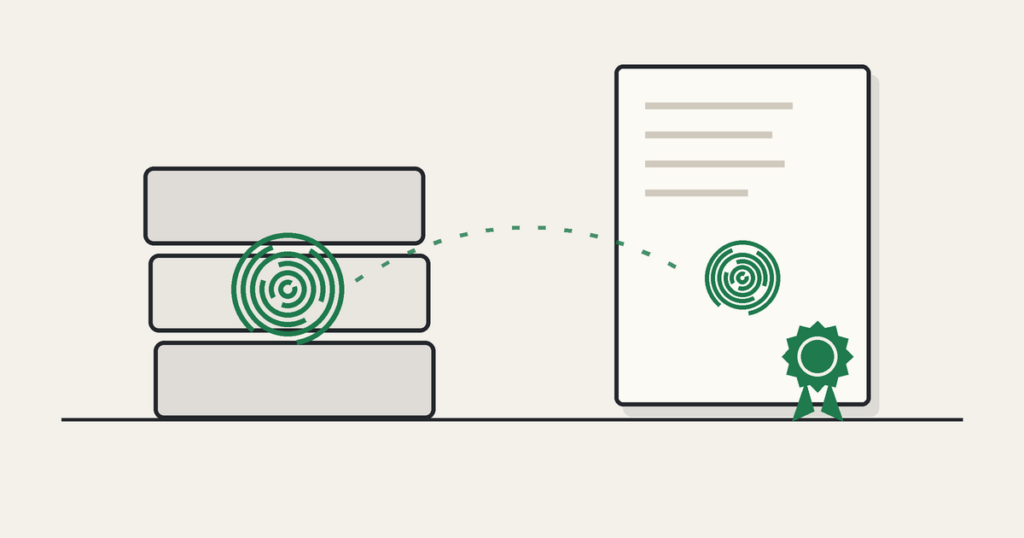
- Generate the digital fingerprint of the code. You do not deposit the source code with the INPI. You generate a hash, a cryptographic digest of the version you want to register, in the algorithm the system indicates (today, SHA-512). The code stays with you, confidential. The hash is the fingerprint: change one character in the code and the hash changes entirely.
- Preserve the exact version that produced the hash. This is the step technical teams botch through haste. The certificate only proves the existence of that exact version. Freeze the commit, export the repository, store it under the company’s control. If you ever need to prove it, you will have to present the code that reproduces that hash.
- Pay the fee and fill in the electronic form. The fee for electronic filing sits around R$185 on the schedule in force as we write this guide. The data is simple: owner, authors, creation date, language, field of application.
- Receive the certificate. With no merit examination, issuance is a matter of days. The INPI has been operating on timelines of roughly one to two weeks, often less.
Notice what did not appear in that flow: a lawyer. A specialized firm helps when there is complicated co-authorship, software inherited from another company or a dispute on the horizon. For the common case, an organized founder registers alone. If you do hire help, the fees usually run several times the official fee, which is still cheap next to the value of the asset.
A recurring doubt: “which INPI class does software go in?”. None. Classes are a trademark concept. Computer programs have their own registration, with no classification by segment. If someone is selling you “software registration in class 42”, they are mixing up the registration of the code with the registration of the product’s trademark, which are different, complementary protections.
The official details of the service, including the current fee table, live on the INPI’s computer programs page.
What about patents? Can software be patented?
The second most common question, and the most confused one. Brazil’s Industrial Property Law expressly excludes the computer program “as such” from what can be patented. Code, as text, is copyright territory.
There is an exception with a long name: the computer-implemented invention. When software is part of a technical solution producing a new technical effect, a data compression method, an industrial control system, the whole may be patentable. It is an expensive, slow, uncertain path that makes sense for a minority of deep techs and for almost none of the companies we usually serve.
The practical ruler: if your edge is the combination of product, execution and distribution, which is the case for practically every SaaS and marketplace, patents are not your fight. Software registration, a registered trademark and a well-written contract cover what needs covering, at a fraction of the cost.
When the registration truly matters
Registering for its own sake is bureaucracy. The registration pays off when it meets one of these four moments.
Investment due diligence. The most frequent trigger. Venture funds treat IP ownership as a checklist item, and missing evidence becomes a condition precedent to the investment, when it does not become a discount on the valuation. Founders who build the three layers before opening the round negotiate without that weight. What funds look at in that process is in our guide to technical due diligence.
A litigious separation. A technical partner who leaves on bad terms, a software house that refuses to hand over the code, a freelancer who reuses your system at the next client. In those scenarios, a certificate dated before the dispute tends to shorten the conversation dramatically.
M&A and large contracts. Strategic buyers and enterprise clients ask the same question the funds do, with more rigor. An INPI certificate is an objective answer at a table where subjective answers get expensive.
Software as a booked asset. Companies that capitalize development or claim innovation incentives need to demonstrate the asset’s existence and ownership. The registration is the natural document.
If none of those moments sits within your 12-to-24-month horizon, the registration can wait without guilt. Layers 1 and 3 cannot: contract and custody get resolved now, because they get resolved with whoever is in front of you today. Ask any founder who tried to negotiate an IP assignment with a provider two years after the contract ended.
Frequently asked questions
How does software registration at the INPI work?
The process is electronic, through the INPI’s e-Software system. You generate a hash (a cryptographic digest) of the code version, fill in the form with the owner’s and authors’ data, pay the fee and receive the certificate within days. The source code is not sent to the INPI; it remains confidential with the company.
How much does it cost to register software with the INPI?
The official fee for electronic filing sits around R$185 (under US$40) on the schedule in force as we write. With a specialized firm’s support, the total usually lands between a few hundred and a few thousand reais, depending on how complex the ownership is.
Can software be patented in Brazil?
The computer program as such is not patentable; code is protected by copyright. Computer-implemented inventions, where software produces a new technical effect inside a larger solution, can be. For the vast majority of SaaS and marketplaces, the path is software registration, trademark and contract, not patents.
Does the INPI registration prove the software is mine?
It proves authorship and precedence: that this version existed on that date, registered under the declared owner. Ownership itself is born in the contract with whoever developed the software. If the IP assignment is not settled in a contract, the registration alone does not replace it.
Do I need to register every new version of the system?
No. The certificate freezes one specific version, and common practice is to register meaningful milestones: the launch, a significant rewrite, the version headed into a due diligence. Incremental changes are protected by copyright from creation, like any code.